AWS Inferentia (Inf1) Technical Review
AWS Inferentia (Inf1) Technical Review
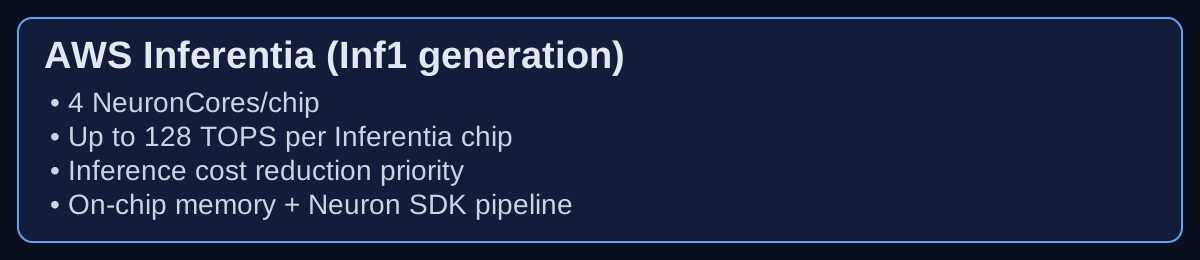
Inferentia’s first generation (deployed through EC2 Inf1) marked AWS’s entry into dedicated inference silicon for cloud-native production workloads. The design target was explicit: reduce cost per inference and improve throughput for mature deep-learning serving patterns while minimizing framework migration cost. AWS paired the chip with the Neuron SDK and integrated it into standard framework flows, which is critical because inference hardware without ecosystem integration rarely sustains broad adoption.
Architecturally, Inf1-era documentation emphasizes four NeuronCores per chip, large on-chip memory behavior, and support for precision modes commonly used in inference optimization. This combination suggests a design tuned for high request density and low-latency serving under constrained power and cost envelopes rather than maximal training flexibility. Inference workloads with stable operator sets and predictable batch dynamics can exploit this style of accelerator effectively.
A key systems insight is that Inf1’s value proposition is operational, not just silicon-level. AWS positioned Inferentia as an EC2-native deployment target with familiar autoscaling, networking, and service integrations. That operational continuity matters: many organizations prefer a 15% lower theoretical peak on a well-integrated platform over a higher peak on a fragmented toolchain. Neuron’s role in compiling and mapping models to NeuronCores is therefore inseparable from the chip architecture itself.
The bottleneck profile in Inf1 deployments often appears in model/operator compatibility and latency-tuning discipline. Teams that align serving stacks with Neuron-optimized execution paths can realize strong economics; teams with frequent custom-operator divergence may face additional integration effort. This is the standard tradeoff in cloud accelerator design: better economics for the mainstream path, higher adaptation cost at the edges.
Inferentia v1’s long-term significance is that it established a cloud-provider-specific inference stack where chip, runtime, and infrastructure policy evolve together. This foundation enabled Inferentia2 to attack latency and memory constraints more aggressively without abandoning workflow continuity.
Additional references consulted
- AWS Inferentia overview: https://aws.amazon.com/ai/machine-learning/inferentia/
- EC2 Inf1 documentation: https://aws.amazon.com/ec2/instance-types/inf1/
- AWS Neuron docs: https://awsdocs-neuron.readthedocs-hosted.com/en/latest/