AWS Trainium1 (Trn1) Technical Review
AWS Trainium1 (Trn1) Technical Review
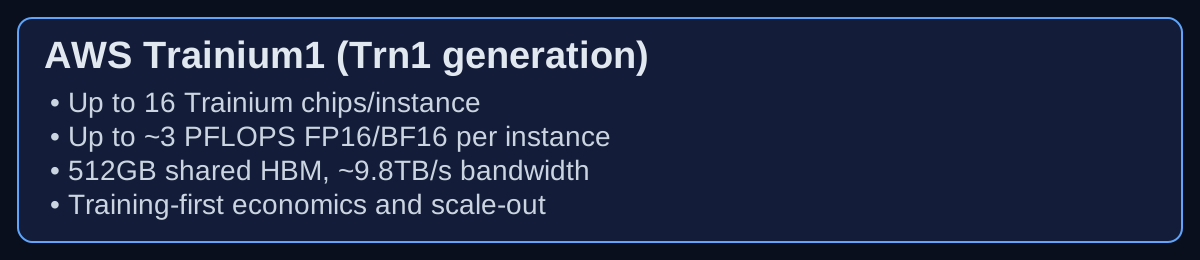
Trainium1, exposed through EC2 Trn1/Trn1n instances, established AWS’s training-focused custom silicon tier. The architecture objective was not merely to provide raw accelerator capacity, but to deliver competitive time-to-train with materially improved cost efficiency for large-model workloads in cloud environments. Public specifications around multi-chip instance composition, substantial shared HBM capacity, and high aggregate memory bandwidth indicate a design built to sustain long training runs under large-batch and distributed regimes.
One key architectural characteristic of Trn1 is scale-out consciousness from day one. AWS highlights high EFA networking throughput and UltraCluster deployment at large chip counts, which implies that Trn1 was designed for distributed training jobs where communication overhead can easily dominate. Hardware and network co-design is essential here: local matrix throughput is not sufficient if cross-node synchronization becomes the critical path.
The Neuron software stack is again central to practical performance. Training accelerators are particularly sensitive to compiler graph partitioning, collective scheduling, precision-casting policy, and kernel fusion behavior. Trn1’s success therefore depends on whether Neuron can keep framework-level ergonomics acceptable while exposing enough low-level controls for performance engineering teams.
Data type support and stochastic rounding features indicate that AWS anticipated fast-evolving mixed-precision training strategies, including efficiency-oriented representations that preserve convergence quality. This is an important design philosophy: training silicon must survive changing model recipes, not just benchmark one static workload.
In production, Trn1 bottlenecks commonly emerge from three system-level zones: input pipeline throughput, communication-compute overlap quality, and memory residency strategy for optimizer/model state. Teams that treat these as first-class engineering domains typically capture the strongest Trn1 gains.
Additional references consulted
- AWS Trainium overview: https://aws.amazon.com/ai/machine-learning/trainium/
- EC2 Trn1 documentation: https://aws.amazon.com/ec2/instance-types/trn1/
- AWS Neuron docs: https://awsdocs-neuron.readthedocs-hosted.com/en/latest/