AWS Trainium3 (Trn3) Technical Review
AWS Trainium3 (Trn3) Technical Review
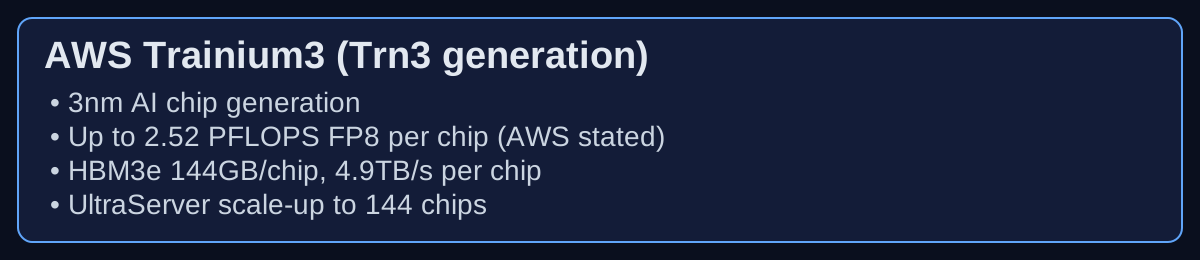
Trainium3 is framed by AWS as a major generational step for frontier AI workloads, combining newer process technology, stronger per-chip compute, larger HBM3e memory footprint, and higher memory bandwidth. Architecturally, this indicates a focus on the workloads currently stressing infrastructure most: long-context models, reasoning-heavy inference, expert-parallel systems, and multimodal generation pipelines that require high memory throughput and low-latency collective behavior.
One important technical shift is that Trn3 is positioned with token economics as a first-class metric, not just aggregate FLOPS. This reflects a broader industry change: production AI value is increasingly measured by end-to-end cost per generated output under latency constraints. Hardware design therefore prioritizes sustained serving/training efficiency under real pipeline conditions rather than isolated peak throughput claims.
AWS also pairs Trn3 with next-generation scale-up fabric components and larger UltraServer domains. This is critical for workloads where model partitioning overhead can erase arithmetic gains. Stronger all-to-all communication behavior in scale-up domains can meaningfully improve both training step efficiency and inference tail latency for large expert-routed models.
Another notable dimension is energy efficiency positioning. As datacenter AI deployment scales, power and cooling budgets increasingly become hard constraints on available compute growth. Trn3’s efficiency claims, if realized in production profiles, suggest an attempt to improve not just raw model speed but the infrastructure sustainability envelope for high-volume AI operations.
The key engineering bottleneck for Trn3 adoption is software exploitation depth. New data formats, kernel pathways, and communication primitives only produce full value when compilers, frameworks, and serving runtimes expose them effectively. Therefore, Trn3 should be evaluated as a full-stack system evolution, not only as a silicon node transition.
Additional references consulted
- AWS Trainium overview: https://aws.amazon.com/ai/machine-learning/trainium/
- EC2 Trn3 UltraServers: https://aws.amazon.com/ec2/instance-types/trn3/
- AWS Neuron platform: https://aws.amazon.com/ai/machine-learning/neuron/