Meta MTIA Roadmap Review (300/400/450/500)
Meta MTIA Roadmap Review (300/400/450/500)
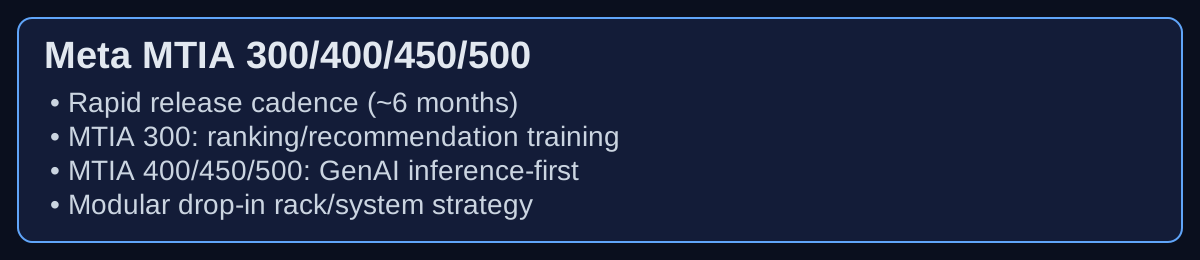
Meta’s roadmap statement describing MTIA 300, 400, 450, and 500 is architecturally significant because it implies a cadence shift from traditional multi-year silicon cycles toward sub-annual iteration. If sustained, this changes how model teams should think about hardware targets. Instead of locking software assumptions to one long-lived generation, teams can design kernels, graph transformations, and deployment plans around a fast-moving sequence of compatible chips.
The roadmap also introduces a clear workload partitioning strategy: MTIA 300 is identified for ranking/recommendation training, while 400/450/500 are framed as broad-capability chips with near-term emphasis on GenAI inference. This is a pragmatic architecture policy. GenAI inference demand is often the most expensive and latency-sensitive portion of production traffic growth. Optimizing those chips first for inference allows better token economics and higher fleet efficiency while preserving fallback capability for other workload classes.
Meta also highlights modularity and rack-level drop-in compatibility. That system-level design choice is as important as chip-level performance. If new generations can be introduced into existing infrastructure with minimal mechanical and power/cooling disruption, time-to-production shortens and fleet upgrade risk declines. In large datacenter operations, this kind of deployment compatibility can dominate total value capture from each new silicon generation.
From a co-design perspective, rapid cadence only works if software and compiler interfaces are stabilized. Frequent hardware changes without stable abstractions would create unsustainable model-porting overhead. Therefore, the roadmap implicitly commits Meta to stronger compatibility guarantees in runtime semantics, kernel development pathways, and serving infrastructure behavior. The architecture challenge shifts from one-time chip optimization to repeatable platform evolution.
The primary risk is roadmap execution under simultaneous pressure from model innovation and manufacturing complexity. Delivering four generations in two years demands tight control over design reuse, verification workflows, and production qualification. If any of those loops becomes the critical path, cadence advantage can erode quickly. But if execution holds, this model could materially improve how quickly Meta aligns hardware capability with rapidly changing AI workload profiles.
Additional references consulted
- Meta roadmap announcement: https://about.fb.com/news/2026/03/expanding-metas-custom-silicon-to-power-our-ai-workloads/
- Meta AI roadmap linkage (from announcement): https://ai.meta.com/blog/meta-mtia-scale-ai-chips-for-billions/
- Meta engineering custom silicon interview context: https://engineering.fb.com/2023/10/18/ml-applications/meta-ai-custom-silicon-olivia-wu/