Meta MTIA v1 Technical Review (Inference-First Custom Silicon)
Meta MTIA v1 Technical Review (Inference-First Custom Silicon)
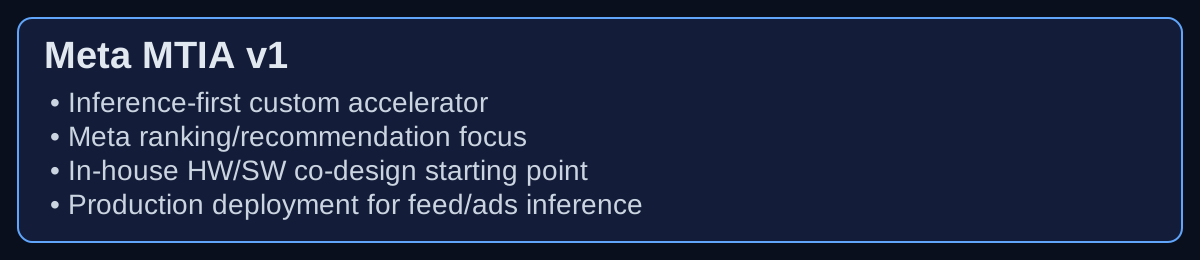
Meta’s first-generation MTIA should be interpreted as a workload-specific infrastructure optimization rather than a generic “NPU launch.” The core problem Meta was trying to solve was recommendation and ranking inference economics at hyperscale. In that operating regime, small inefficiencies in memory access patterns, operator scheduling, and model serving pipelines compound into very large fleet-level cost and energy penalties. MTIA v1 was designed to move this workload class onto a custom acceleration path where hardware behavior is better aligned with Meta’s software stack and model characteristics.
From an architecture perspective, the most important v1 characteristic is not a public benchmark number; it is the co-design workflow. Meta repeatedly describes a tight hardware/software loop where model teams, PyTorch ecosystem engineers, runtime developers, and silicon teams iterate together. This is significant because recommendation inference often contains irregular access behavior and mixed compute kernels that do not always map efficiently to commodity accelerator assumptions. A co-designed custom accelerator can prioritize the exact operator mix and execution patterns that dominate production latency and throughput.
The v1 deployment also demonstrates a strategic separation of concerns inside Meta’s compute portfolio. MTIA v1 is not positioned as a universal replacement for partner silicon. Instead, it is introduced as a targeted engine for internal high-volume inference paths where Meta can guarantee software fit and operational control. This portfolio stance reduces risk: custom silicon is applied where it has strongest deterministic advantage, while external accelerators continue to serve broader or rapidly changing workload envelopes.
For system engineers, MTIA v1 implies a different optimization hierarchy compared with cloud-general accelerators. The value proposition is achieved when the full stack is tuned end-to-end: graph lowering, kernel fusion behavior, serving batch policy, memory residency strategy, and deployment topology. If any one of these layers is not aligned, a custom chip can underperform relative to its theoretical efficiency envelope. In other words, MTIA v1 is an architecture that rewards organizational co-design maturity as much as hardware quality.
The principal bottleneck to watch in v1-era deployments is software generality versus specialization depth. The tighter a chip is tuned to specific recommendation/ranking patterns, the more adaptation effort may be required for rapidly evolving GenAI-style workloads. That does not invalidate the design; it clarifies why Meta’s roadmap quickly moved toward subsequent generations and broader workload coverage.
Additional references consulted
- Meta custom silicon interview (Olivia Wu): https://engineering.fb.com/2023/10/18/ml-applications/meta-ai-custom-silicon-olivia-wu/
- Meta AI MTIA introduction reference link (from Meta sources): https://ai.meta.com/blog/meta-training-inference-accelerator-AI-MTIA/
- Meta custom silicon strategy update: https://about.fb.com/news/2026/03/expanding-metas-custom-silicon-to-power-our-ai-workloads/