Meta MTIA v2 Technical Review (Hardware/Software Co-Design at Scale)
Meta MTIA v2 Technical Review (Hardware/Software Co-Design at Scale)
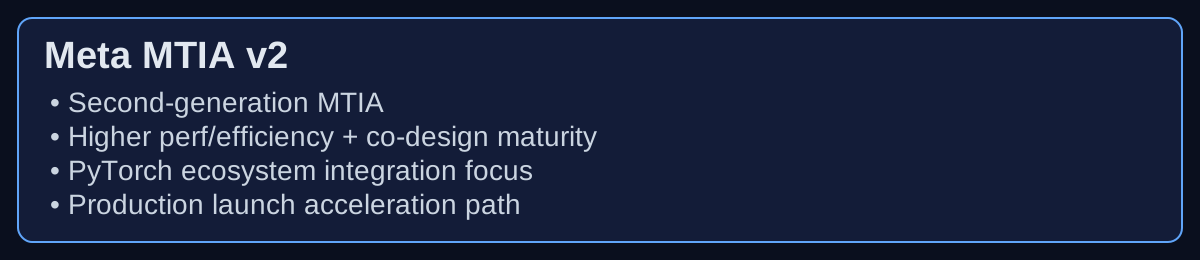
MTIA v2 is best understood as the generation where Meta attempted to industrialize custom-AI acceleration rather than merely proving technical feasibility. Public engineering material around v2 emphasizes joint optimization between silicon features, software runtime behavior, and model architecture requirements in production recommendation/inference pipelines. That emphasis is architecturally important: once custom silicon is deployed at scale, developer experience and software integration quality often become larger determinants of real throughput than isolated microarchitectural improvements.
A notable v2 signal is Meta’s focus on the PyTorch ecosystem and production launch readiness. This indicates that MTIA evolution is being steered by software adoption friction as much as by raw hardware metrics. In practical terms, faster bring-up, fewer model-porting surprises, and predictable profiling behavior can produce larger business impact than incremental arithmetic throughput when serving traffic is measured in massive daily request volumes.
From a systems perspective, v2 suggests a transition from “chip as accelerator” to “chip as platform component.” That means firmware, compiler, operator libraries, debugging tools, and deployment orchestration become first-class architecture surfaces. The hardware is still central, but it is no longer sufficient by itself. Meta’s own framing around co-design examples implies that specific silicon capabilities are only valuable when software can discover and exploit them automatically in model pipelines.
Another key implication is architectural optionality. If v2 successfully improves the hardware/software interface, Meta can iterate faster on subsequent silicon generations without forcing disruptive rewrites of high-level model code. This is one of the strongest long-term advantages of in-house silicon: once internal tooling and abstractions are stable, each generation can focus more aggressively on workload-tailored hardware advances while preserving developer continuity.
The dominant v2 bottleneck is therefore not only compute density; it is integration velocity across teams. If model teams move faster than compiler/runtime support, utilization falls. If hardware adds features faster than software can expose, those features remain latent. MTIA v2’s real achievement is measured by how effectively those cycles are synchronized in production.
Additional references consulted
- Meta MTIA v2 co-design talk summary: https://engineering.fb.com/2024/08/22/ml-applications/meta-mtia-hardware-co-design/
- Meta next-generation MTIA reference link (from Engineering at Meta page): https://ai.meta.com/blog/next-generation-meta-training-inference-accelerator-AI-MTIA/
- Meta custom silicon strategy update: https://about.fb.com/news/2026/03/expanding-metas-custom-silicon-to-power-our-ai-workloads/