TPU v1 Technical Review (Inference-First Accelerator)
TPU v1 Technical Review (Inference-First Accelerator)
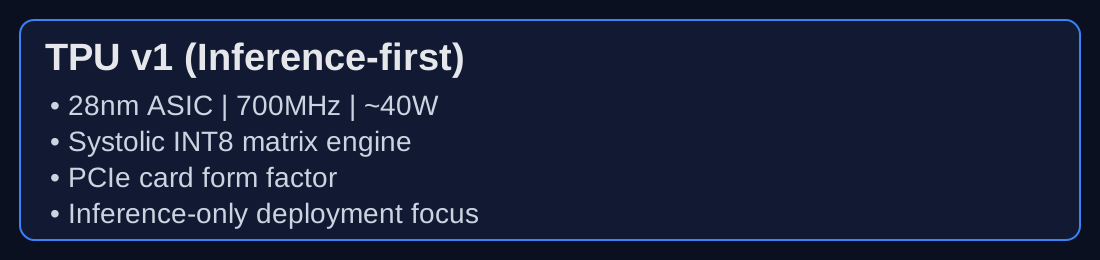
Google’s first TPU should be understood as a response to a datacenter systems problem, not as an isolated chip-design exercise. Around the mid-2010s, production inference demand for ranking, speech, vision, and translation was increasing faster than conventional CPU scaling and faster than the practical cost envelope of GPU-heavy serving fleets. TPU v1 therefore targeted the point where service-level objectives (latency, throughput, and energy per query) intersected with hardware efficiency. The central design hypothesis was that if most production inference can be represented as dense matrix operations plus lightweight activation/post-processing, then a domain-specific accelerator with deterministic dataflow can dominate a general-purpose architecture on both performance-per-watt and rack-level economics.
Architecturally, TPU v1 emphasized systolic-style matrix computation with quantized inference as a first-class assumption. This was a decisive choice. A systolic array is not simply “many MAC units”; it is a communication discipline in which operands flow rhythmically through local interconnect, allowing massive reuse of weights and activations while minimizing expensive global data movement. In practical terms, this means the chip’s effective performance is less sensitive to instruction overhead and more sensitive to memory staging and tensor tiling quality. The broader implication is that TPU v1 shifted optimization authority from out-of-order instruction scheduling to compile-time and runtime tensor orchestration.
From a systems integration perspective, Google’s decision to deploy TPU v1 as a host-attached datacenter card was equally important. The chip was designed to fit quickly into existing fleet infrastructure, prioritizing time-to-deployment and service impact rather than waiting for a full platform redesign. This deployment model preserved compatibility with established host software and cluster operations while still injecting a highly specialized compute path for inference-critical kernels. The result was a practical hybrid: general-purpose host orchestration combined with domain-specific matrix acceleration.
A subtle but technically meaningful point is how TPU v1 reframed bottlenecks. On CPUs, inferencing often spends disproportionate energy and time on instruction/control overhead, cache behavior mismatch, and memory indirection. TPU v1 reduced that overhead for supported workloads, so bottlenecks moved “upstream” and “sideways”: model operator coverage, quantization fidelity, host-device pipeline efficiency, and tensor layout transformations became the new constraints. In other words, the chip solved one class of bottlenecks so effectively that software-stack maturity became the next limiter.
For model developers, TPU v1 created a new optimization target: maximize arithmetic intensity under quantized constraints while minimizing host-device synchronization boundaries. Models with regular matrix-dominant execution patterns benefited most. Models with highly irregular control flow or custom operators faced adaptation cost. This is a recurring accelerator lesson: specialization wins decisively when the software surface is co-designed for the dominant workload class, but it exposes friction at the edges of that class.
Historically, TPU v1’s greatest technical significance is that it validated domain-specific acceleration at hyperscale in production, not just in benchmark environments. It proved that hardware/software co-design could move enterprise inference economics by an order that mattered for real services. Once that happened, the architectural roadmap naturally moved toward training-capable generations with larger memory systems and stronger interconnect fabrics. In that sense, TPU v1 is best viewed as the “inference proof” that unlocked the distributed TPU era.
Sources
Primary references include Google’s deep-dive engineering blog on first-generation TPU design and deployment and the ISCA paper In-Datacenter Performance Analysis of a Tensor Processing Unit (arXiv:1704.04760), which quantified production inference behavior and efficiency characteristics.
Additional references consulted
- Google Cloud Blog (first TPU deep dive): https://cloud.google.com/blog/products/ai-machine-learning/an-in-depth-look-at-googles-first-tensor-processing-unit-tpu
- ISCA paper (v1): https://arxiv.org/abs/1704.04760
- Wikipedia TPU overview (cross-check timeline): https://en.wikipedia.org/wiki/Tensor_Processing_Unit