TPU v2 Technical Review (Training-Capable Cloud TPU Era)
TPU v2 Technical Review (Training-Capable Cloud TPU Era)
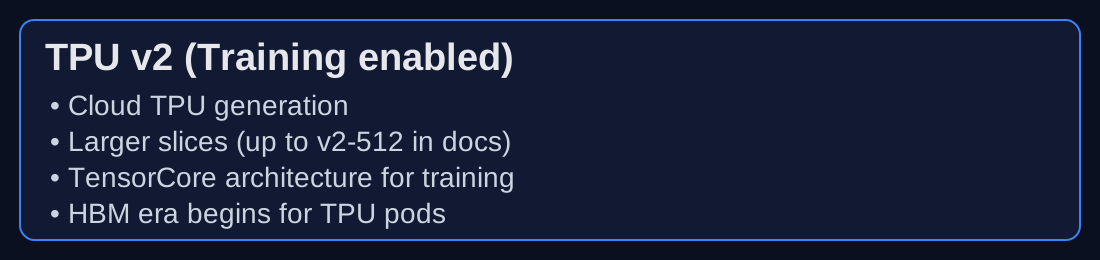
TPU v2 represents the architectural moment when Google’s TPU program expanded from inference acceleration into distributed training infrastructure. This transition is deeper than a feature addition. Inference-first accelerators optimize steady-state serving efficiency, but training systems require a different balance: higher numerical throughput under backpropagation, larger model-state memory pressure, heavy collective communication, and robust multi-device synchronization. TPU v2 introduced Cloud TPU as an allocatable, slice-based training resource, effectively shifting TPU from “specialized coprocessor in service stacks” to “first-class distributed compute target in cloud orchestration.”
Technically, TPU v2’s significance lies in opening the path to pod-scale training economics. Once training enters scope, arithmetic throughput is only one part of wall-clock performance. Training step time depends on model partition strategy, gradient synchronization cost, host input pipeline quality, and memory residency behavior. TPU v2 therefore established the foundational design pattern that later TPU generations would extend: matrix-centric TensorCore execution, high-bandwidth memory locality, and topology-aware scale-out slices exposed directly through cloud APIs.
The cloud-facing accelerator type model (for example v2-8 through larger v2 slices) may look operational, but it is architecturally consequential. It encodes a philosophy in which hardware topology is not hidden from users; instead, users and frameworks are encouraged to think in terms of slice size, partition geometry, and communication behavior. This effectively pushes distributed-systems concerns closer to model-development practice. Framework compilers and runtime systems become increasingly responsible for mapping graph structure onto physical topology in a way that preserves high utilization.
Another major shift in the v2 era is where complexity lives. In v1-style inferencing, complexity was concentrated in quantization and serving integration. In v2 training, complexity moved into global system behavior: all-reduce efficiency, sharding strategy, replication balance, and failure-aware scheduling. This means chip-level improvements can be muted or amplified depending on software stack quality. Practically, two teams using the same TPU slice can see very different results if one has better input pipeline overlap, tensor partitioning, and communication-compute overlap.
From a microarchitectural perspective, v2 should be read as a bridge generation: it proved that TPU could sustain meaningful training workloads at cloud scale while exposing the next set of bottlenecks that required v3/v4 evolution. As model dimensions grew, memory capacity and interconnect efficiency became dominant constraints. That is exactly what later generations attacked more aggressively. In this sense, TPU v2 was less about peak headline metrics and more about validating the end-to-end training platform model.
The long-term engineering legacy of v2 is institutional: it normalized accelerator-native training in cloud production environments. It forced tooling ecosystems to mature around accelerator-aware compilation, distributed checkpointing, and topology-constrained execution planning. Without this transitional generation, later pod-scale TPU systems would have had excellent raw hardware but insufficient operational pathway to broad developer productivity.
Sources
This review relies on Google Cloud TPU v2 documentation and the distributed TPU architecture context established in Jouppi et al.’s pod-scale training work, particularly the paper A Domain Specific Supercomputer for Training Deep Neural Networks.
Additional references consulted
- Cloud TPU v2 documentation: https://docs.cloud.google.com/tpu/docs/v2
- Domain-Specific Supercomputer paper (v2/v3 pod context): https://dl.acm.org/doi/pdf/10.1145/3360307
- Wikipedia TPU overview (cross-check chronology): https://en.wikipedia.org/wiki/Tensor_Processing_Unit