TPU v3 Technical Review (Memory and Pod-Scale Training Maturity)
TPU v3 Technical Review (Memory and Pod-Scale Training Maturity)
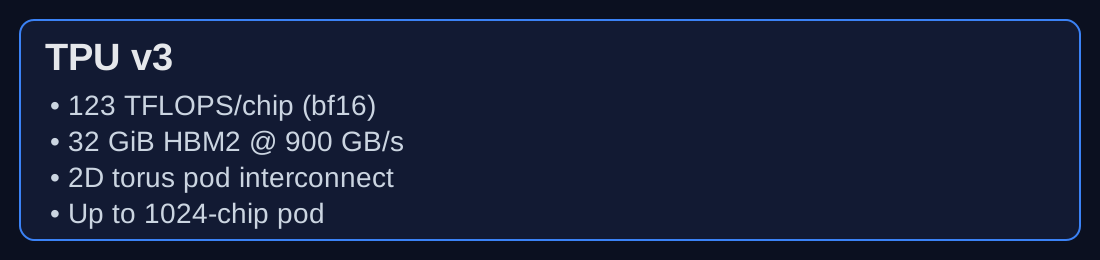
TPU v3 is where the TPU program moved from “training-capable” to “training-mature” at cloud scale. Public documentation highlights a profile of 123 TFLOPS bf16 per chip, 32 GiB HBM2, 900 GB/s memory bandwidth per chip, and 2D torus pod interconnect up to very large slice sizes. The key engineering interpretation is that v3 delivered a more balanced ratio between arithmetic throughput and memory capacity than earlier generations, allowing larger practical model envelopes before rematerialization or microbatch compromises became unavoidable.
The most important point is that v3 gains were not purely about increasing peak compute. In large training jobs, practical throughput often degrades when memory limits force aggressive recomputation, awkward partitioning, or frequent host interaction. By increasing memory capacity and maintaining high memory bandwidth, v3 improved the feasibility of running deeper networks and larger activation footprints without pathological overhead. This translates to better effective throughput even when nominal FLOPS scaling seems moderate.
At pod scale, the 2D torus interconnect was sufficient to support strong distributed training but still demanded communication-aware software design. Collective operations and cross-replica synchronization remain sensitive to topology diameter and traffic patterns. Therefore, v3 performance depended heavily on how frameworks mapped model/data parallel strategy onto physical topology. Teams that ignored communication structure often encountered scaling cliffs despite abundant chip-level compute.
Another important engineering lesson from v3 documentation is the persistent risk of input pipeline bottlenecks. As compute gets faster, data staging and host preprocessing become more visible constraints. If infeed is under-optimized, the accelerator can idle regardless of theoretical peak performance. In practice, v3 forced many teams to treat data pipeline engineering as a co-equal optimization domain with model architecture and kernel efficiency.
Microarchitecturally, v3’s two TensorCore per chip organization with matrix, vector, and scalar execution resources reflects a sustained commitment to dense tensor math while keeping enough flexibility for non-MXU operations in training graphs. This combination reduced dependence on host-side fallback and enabled higher on-device execution continuity. The practical outcome is fewer disruptive context transitions and better step-time stability under mixed operator workloads.
From a historical viewpoint, TPU v3 marks the point where the software ecosystem had to fully internalize distributed accelerator realities. Performance became less about isolated kernel speed and more about end-to-end graph placement, communication overlap, data pipeline depth, and memory residency strategy. That systems-level maturity set the stage for v4’s major topology shift.
Sources
Primary references are the Cloud TPU v3 architecture documentation and the distributed TPU system paper A Domain Specific Supercomputer for Training Deep Neural Networks, which provides context for pod behavior and large-scale training economics.
Additional references consulted
- Cloud TPU v3 documentation: https://docs.cloud.google.com/tpu/docs/v3
- Domain-Specific Supercomputer paper (v2/v3 pod context): https://dl.acm.org/doi/pdf/10.1145/3360307
- Wikipedia TPU overview (cross-check chronology): https://en.wikipedia.org/wiki/Tensor_Processing_Unit