TPU v4 Technical Review (Interconnect-First Supercomputer Design)
TPU v4 Technical Review (Interconnect-First Supercomputer Design)
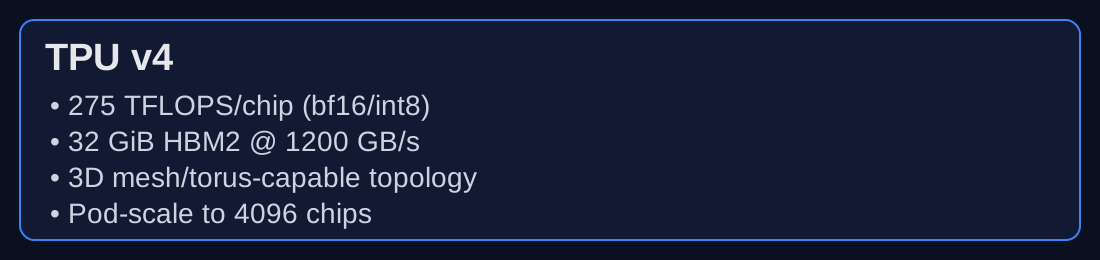
TPU v4 is best analyzed as an interconnect and systems architecture leap as much as a compute-core upgrade. Public specifications report 275 TFLOPS (bf16/int8) per chip, 32 GiB HBM2 at 1200 GB/s, and pod-scale topologies reaching thousands of chips with 3D mesh/torus-capable arrangements. The crucial architectural shift is that v4 elevated network topology from a scaling detail to a central design axis. At this scale, model training performance is governed as much by communication diameter and collective efficiency as by local matrix throughput.
The move from predominantly 2D torus-era assumptions to 3D mesh and torus-capable configurations reduced communication path length for large distributed jobs and improved the conditions for all-reduce-heavy training loops. For modern transformer-style workloads with frequent synchronization phases, this matters directly for time-to-train. A system can have extraordinary chip FLOPS and still underdeliver if interconnect behavior amplifies synchronization stalls. v4 addresses that risk by making topological flexibility a first-class operational capability.
Memory-system behavior in v4 also signals a mature co-design philosophy. Documentation emphasizes improved HBM performance characteristics, stronger DMA behavior, and NUMA-aware host-side guidance. These are not cosmetic details. They indicate the platform has reached a point where software placement and host-memory policy can materially change realized accelerator efficiency. In other words, v4’s architecture assumes users will perform system-level tuning, not just model-level tuning.
An underappreciated technical theme in v4 is orchestration complexity. As topology options increase, scheduling quality becomes performance-critical. The same number of chips can produce different outcomes depending on how jobs are placed and how traffic patterns align with fabric geometry. This makes runtime/compiler and scheduler integration a hard requirement for extracting full value. The accelerator is no longer the only optimization object; the cluster becomes the optimization object.
From a roofline perspective, v4 improves both compute and memory ceilings, but the practical frontier often sits at communication-compute overlap and collective efficiency under scale. Teams that structure training loops to overlap communication with useful local compute benefit disproportionately. Teams that maintain strict serialized synchronization behavior leave significant performance on the table regardless of hardware generation.
Historically, v4 marks TPU’s arrival as a supercomputer-class ML platform rather than a mere accelerator family. Its innovation is systemic: chip design, memory hierarchy, interconnect topology, and software operational guidance were all aligned around large-scale training as a native workload. That architectural integration is why v4 remains a reference point for infrastructure-level AI system design.
Sources
This review is based on Cloud TPU v4 documentation and the TPU v4 paper An Optically Reconfigurable Supercomputer for Machine Learning with Hardware Support for Embeddings (arXiv:2304.01433), which details architectural and system-level motivations.
Additional references consulted
- Cloud TPU v4 documentation: https://docs.cloud.google.com/tpu/docs/v4
- TPU v4 architecture paper: https://arxiv.org/pdf/2304.01433
- Wikipedia TPU overview (cross-check chronology): https://en.wikipedia.org/wiki/Tensor_Processing_Unit