TPU v5e Technical Review (Efficiency-Tier Train+Serve Platform)
TPU v5e Technical Review (Efficiency-Tier Train+Serve Platform)
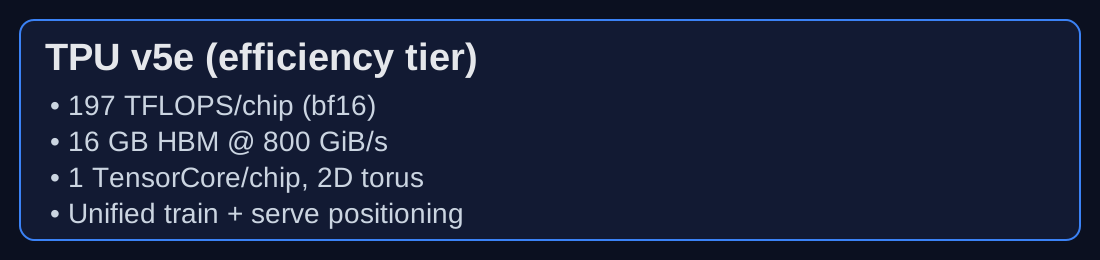
TPU v5e introduces a clear product-architecture statement: not every valuable AI deployment requires the most extreme training-tier hardware. Publicly documented characteristics include 197 TFLOPS bf16 per chip, 393 TOPS int8, 16 GB HBM at 800 GiB/s, one TensorCore per chip, and 2D torus pod scaling up to 256 chips. This profile indicates an intentional efficiency tier tuned for broad train-and-serve economics rather than absolute frontier throughput.
From an architecture standpoint, v5e is interesting because it treats deployment mode as part of hardware value. Cloud documentation explicitly distinguishes serving-oriented and training-oriented usage patterns. That is a systems-level acknowledgement that latency-sensitive serving and throughput-driven training stress infrastructure differently, even on the same silicon. By exposing this distinction in provisioning semantics, v5e aligns operational behavior with workload intent, which reduces friction for production teams.
The memory profile (16 GB HBM per chip) is a key tradeoff. It is sufficient for many modern workloads, especially when paired with efficient sharding and quantization strategies, but it can constrain very large parameter models or long-context scenarios if users attempt naive scaling. Therefore, v5e rewards software maturity: model partitioning, activation checkpoint policy, tensor-parallel layout, and kernel fusion decisions have outsized impact on realized performance.
Interconnect design also reflects the target market. The 2D torus and moderate pod scale suit a broad class of practical deployments where cluster complexity must remain manageable. This lowers operational barrier relative to hyperscale-only architectures while still enabling meaningful distributed jobs. In effect, v5e chooses deployment accessibility and fleet efficiency as first-class design goals.
A notable technical implication is that v5e reduces the “all or nothing” posture many teams historically faced with accelerators. Teams can build end-to-end pipelines where experimentation, fine-tuning, and serving all run on a coherent platform tier, then selectively graduate only the heaviest workloads to higher-end systems. This improves capacity planning and can reduce engineering overhead in mixed-stage ML lifecycle operations.
In bottleneck terms, v5e’s dominant constraints are usually memory footprint pressure and suboptimal parallelization strategy, not raw matrix throughput per se. Well-optimized software stacks can extract strong value from v5e, but poorly partitioned workloads may quickly become memory-bound or communication-bound. The generation therefore reinforces a broader trend: accelerator effectiveness is increasingly determined by software and orchestration quality.
Sources
This review relies on the Cloud TPU v5e architecture and configuration documentation, including public specifications for compute, memory, networking, and serving/training provisioning behavior.
Additional references consulted
- Cloud TPU v5e documentation: https://docs.cloud.google.com/tpu/docs/v5e
- Google Cloud TPU landing page: https://cloud.google.com/tpu
- SemiAnalysis TPU search page (external analyst index): https://semianalysis.com/?s=TPU+v5p