TPU v5p Technical Review (High-Performance Training Tier)
TPU v5p Technical Review (High-Performance Training Tier)
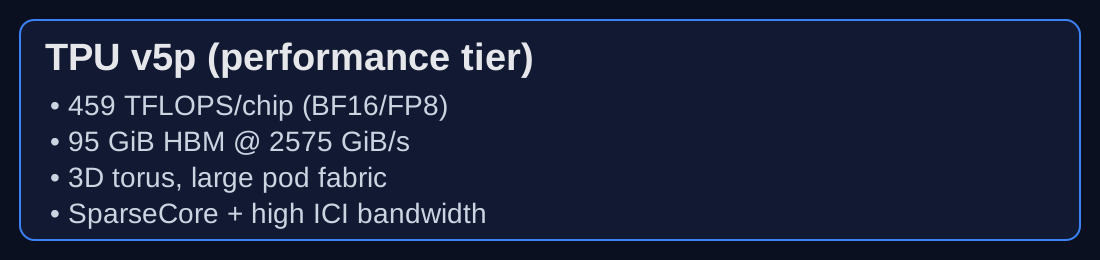
TPU v5p is the high-performance training counterpart to v5e’s efficiency-oriented positioning. Public documentation describes a markedly stronger per-chip profile: 459 TFLOPS (BF16/FP8), 95 GiB HBM, 2575 GiB/s memory bandwidth, dual TensorCores per chip, SparseCore support, and high-bandwidth 3D torus interconnect in very large pod contexts. The architectural story is straightforward: v5p is designed to compress time-to-train for frontier-scale workloads where both memory capacity and communication throughput are hard constraints.
The jump in HBM capacity is especially important. In large-model training, memory capacity is not merely a convenience; it governs feasible batch structure, sequence length strategy, optimizer-state residency, and rematerialization pressure. More memory per chip allows cleaner partitioning and can reduce expensive recomputation cycles, which often improves effective throughput more than arithmetic uplift alone. This is why v5p should be interpreted as a “memory-and-fabric” generation, not only a compute generation.
Fabric design further reinforces this interpretation. As model parallelism scales, synchronization overhead can dominate step time. A high-bandwidth 3D torus reduces the risk that collective operations erase local compute gains. Documentation around resiliency behavior in optical interconnect regions is also significant: large clusters need predictable availability, and temporary degraded routing is often preferable to hard scheduling failure. This reflects production-oriented supercluster thinking rather than lab-benchmark thinking.
SparseCore integration introduces another practical dimension: modern recommendation and sparse-feature-heavy workloads can benefit from dedicated sparse computation pathways that reduce pressure on dense matrix engines. This is architecturally notable because it broadens v5p beyond pure dense-transformer optimization and suggests explicit attention to workload diversity in hyperscale environments.
Operationally, v5p increases the importance of scheduler quality and topology-aware placement. At this scale, “same chip count” does not imply “same performance.” Placement geometry, communication overlap strategy, and runtime partition policy can produce meaningful performance variance. Teams that treat cluster orchestration as a first-class optimization domain extract the most value from v5p; teams that rely on generic defaults may underutilize expensive hardware.
The practical bottleneck in v5p environments is rarely peak MAC throughput. It is usually one of three systemic factors: communication inefficiency in collectives, memory-layout mismatch with model partitioning, or data pipeline imbalance at scale. Therefore, v5p’s full value appears only when hardware, compiler/runtime, and training-system engineering are tuned as one stack.
Sources
This review is based on Cloud TPU v5p technical documentation covering chip-level specifications, pod/slice topology, interconnect behavior, and VM/host characteristics.
Additional references consulted
- Cloud TPU v5p documentation: https://docs.cloud.google.com/tpu/docs/v5p
- Google Cloud TPU landing page: https://cloud.google.com/tpu
- SemiAnalysis TPU search page (external analyst index): https://semianalysis.com/?s=TPU+v5p