TPU v6e (Trillium) Technical Review (Performance Jump in Efficiency Class)
TPU v6e (Trillium) Technical Review (Performance Jump in Efficiency Class)
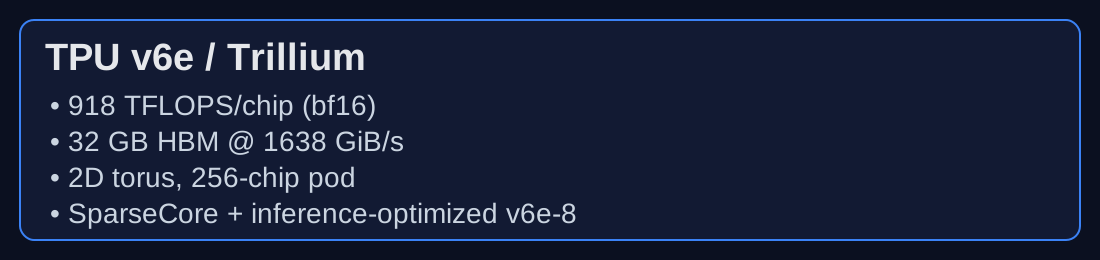
TPU v6e (Trillium) is technically interesting because it raises performance substantially while retaining an efficiency-class deployment philosophy. Public documentation reports 918 TFLOPS bf16 per chip, 1836 TOPS int8, 32 GB HBM at 1638 GiB/s, SparseCore support, and 2D torus pod organization at 256-chip scale. That combination suggests a deliberate strategy: increase per-chip capability enough to absorb more demanding workloads while preserving the operational simplicity and broad applicability expected from a mainstream cloud TPU tier.
Compared with v5e, v6e’s throughput and memory subsystem improvements materially shift feasible workload envelopes. Many model configurations that previously required aggressive compromise in microbatching, activation management, or serving parallelism can now run with cleaner scheduling and lower orchestration overhead. This matters in production because engineering complexity is itself a cost center; reducing the need for fragile optimization tricks often produces better reliability and faster iteration cycles.
A key systems feature is the explicit v6e-8 serving configuration in which eight chips are attached to a single VM for inference-oriented behavior. This is more than a SKU detail. It indicates co-design between hardware topology and serving software expectations: users can target low-latency, high-throughput inference with fewer cross-host coordination points. For multi-host inference, Google’s documented pathway support extends scale while preserving a coherent operational model.
Architecturally, v6e maintains the principle that balanced systems beat peak-component bragging rights. Compute uplift without memory and interconnect balance would create artificial bottlenecks, but v6e’s documented bandwidth and network configuration indicate an effort to keep those subsystems aligned. The result is a platform that can function as both a training/fine-tuning target and a production serving target with less role fragmentation across hardware tiers.
The major engineering decision for practitioners is now tier selection rather than mere hardware access. Teams must evaluate whether workload shape favors v6e’s strong unified profile or requires v5p-style extreme memory/fabric characteristics for very large frontier training. This is a healthy sign of platform maturity: hardware choices map to workload economics rather than marketing categories.
In bottleneck terms, v6e environments typically expose software-stack issues once baseline hardware constraints are reduced. Kernel fusion quality, communication overlap, host preprocessing, and checkpoint/restart behavior become dominant determinants of total system efficiency. As with previous TPU generations, the strongest outcomes come from full-stack tuning rather than chip-centric optimization alone.
Sources
This review is based on Cloud TPU v6e (Trillium) technical documentation, including architecture, topology, VM profiles, and serving/training deployment guidance.
Additional references consulted
- Cloud TPU v6e documentation: https://docs.cloud.google.com/tpu/docs/v6e
- Google Cloud TPU landing page: https://cloud.google.com/tpu
- SemiAnalysis Trillium search page (external analyst index): https://semianalysis.com/?s=Trillium